The HUAWEI MatePad Air (2026) is a tablet that puts a strong emphasis on portability, display quality and battery life. At just 5.3mm thick and weighing 509g, it is remarkably thin and light for a 12-inch tablet, while still offering a large OLED display, a 10,100mAh battery and support for accessories such as the Smart Magnetic Keyboard and M-Pencil Pro.
On paper, the HUAWEI MatePad Air looks like a tablet designed to handle everything from productivity and entertainment to note-taking and video calls. We’ve been using the tablet for a couple of weeks; let’s dive into the full review.
Design

The HUAWEI MatePad Air has a slim and minimalist design that makes it easy to carry around. Measuring just 5.3mm thick and weighing 509g, it feels considerably more portable than what you might expect from a 12-inch tablet.
It features an aluminium frame, a flat rear panel and curved edges, with uniform bezels surrounding the display. The combination gives the tablet a clean appearance while making it comfortable to hold, particularly when using it in portrait orientation.
Despite the slim profile, HUAWEI says the MatePad Air offers 17% better bend resistance compared with the MatePad 12X. While this is not something that is immediately noticeable during normal use, it does add some reassurance given how thin the tablet is.

The MatePad Air is available in Airy Blue, Sakura Pink and White, giving users a few options depending on their preferred style.
One of the main advantages of the design is simply how easy the tablet is to carry. At 509g, it can be used for extended periods without feeling excessively heavy, while the thin profile makes it convenient to slip into a bag alongside a laptop or other accessories.
Accessories

The HUAWEI MatePad Air can also be paired with accessories that expand its functionality. All the official accessories are connected via NearLink, a new short-range wireless communication technology developed by Huawei and the SparkLink Alliance as a faster, lower-latency alternative to Bluetooth and Wi-Fi.
The Smart Magnetic Keyboard doubles as a protective cover and stand, while providing a physical keyboard for typing. It supports two positions, allowing users to adjust the tablet for different scenarios such as typing or watching videos. The keyboard helps turn it into a more productivity-focused device when longer documents or emails need to be typed.
For creative work and handwritten notes, the tablet supports the M-Pencil Pro. Unfortunately, we do not have the M-Pencil Pro with us.
12-inch OLED Display with PaperMatte Technology

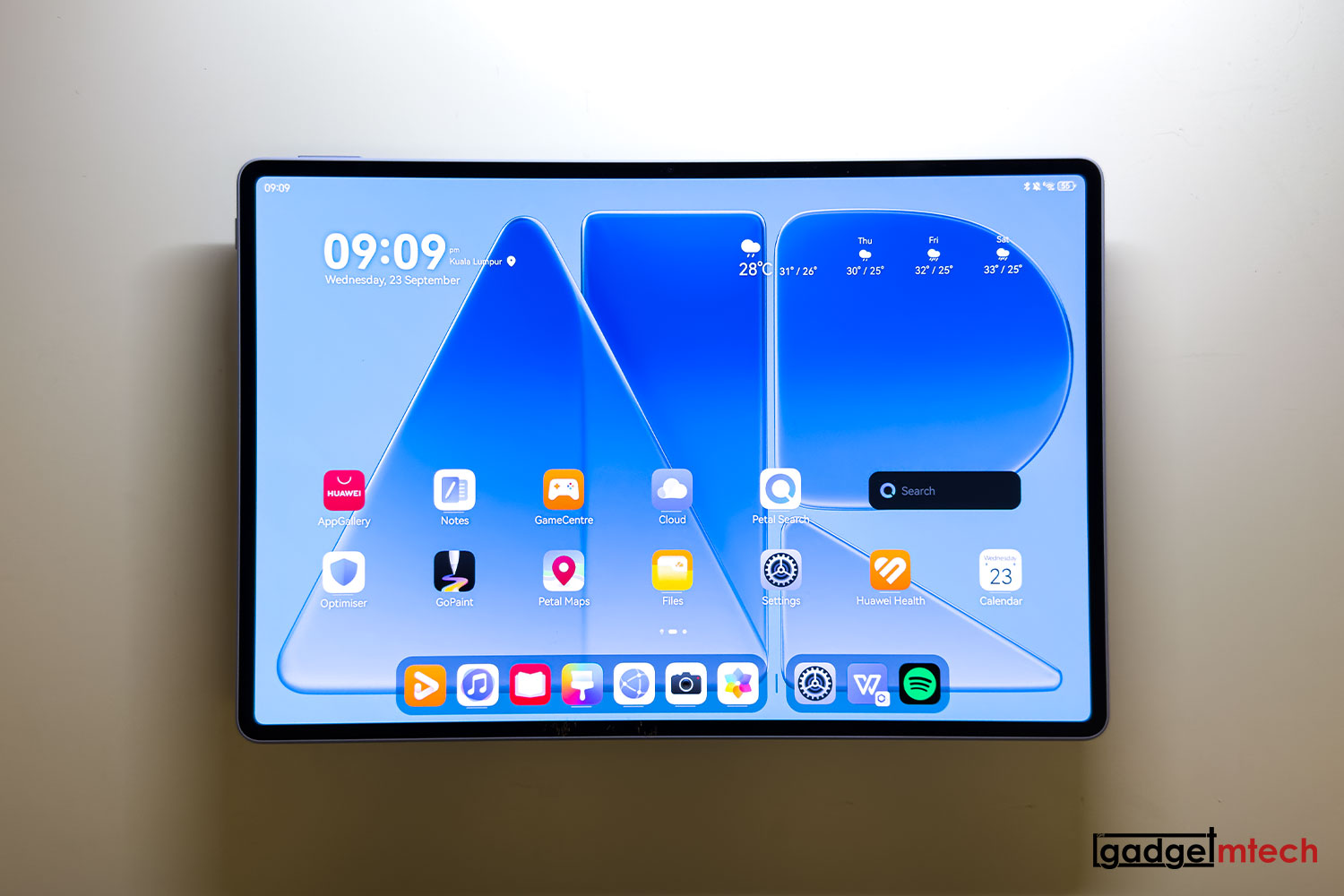
The display is arguably one of the main attractions of the HUAWEI MatePad Air. It features a 12-inch OLED panel with a 2,800 x 1,840 resolution, resulting in a pixel density of 275ppi.
The display also supports a 144Hz refresh rate, which makes scrolling through webpages, navigating the interface and using supported applications feel smooth. With a 92% screen-to-body ratio, most of the front is dedicated to the display, giving the MatePad Air a spacious viewing area.
Brightness can reach up to 1,200 nits when the battery level is above 20%, providing enough brightness for comfortable viewing in brighter environments.
The model tested here also features HUAWEI’s PaperMatte technology. Rather than using a conventional glossy tablet display, the anti-glare matte surface is designed to reduce reflections and fingerprints while providing a texture that feels more like writing on paper. This makes a noticeable difference when using the tablet for reading, writing or drawing.
At the same time, the matte finish is not only about stylus input. It can also make the screen more comfortable to look at in environments with strong lighting, as there are fewer distracting reflections.
Audio

For entertainment, the HUAWEI MatePad Air comes with a six-speaker setup. The speakers deliver rich and balanced audio, making the tablet suitable for watching videos, listening to music and taking part in video calls without immediately needing external speakers.
There is no 3.5mm headphone jack, so wired headphones need to connect through USB-C, while wireless audio is handled through Bluetooth 5.2.
Performance

Under the hood, the HUAWEI MatePad Air is powered by the Kirin T93C, which is based on a 7nm architecture. Its performance is comparable to older flagship smartphone platforms such as the Snapdragon 888.
For everyday tasks, the MatePad Air performs well enough. Switching between applications, browsing the web, watching videos and handling general productivity tasks are generally smooth, although there can be occasional minor stutters during use.
The limitations become more obvious when pushing the tablet harder. This is not a tablet aimed at users who expect flagship-level gaming performance, particularly with demanding 3D titles. This means users looking for a tablet primarily for high-end gaming may need to take the MatePad Air’s performance limitations into consideration.
Storage is another area worth noting. The tablet comes with 8GB of RAM and 256GB of internal storage. However, the storage is non-expandable, so users who intend to keep a large collection of games, videos and other files on the device should consider their storage requirements before purchasing.
HarmonyOS

The software experience is perhaps the biggest consideration for potential buyers. The HUAWEI MatePad Air runs HarmonyOS 4.3 and relies on Huawei Mobile Services rather than Google’s mobile services.
As a result, Google Play Services are not natively available. This can be an inconvenience for users who depend heavily on applications and services within Google’s ecosystem.
There are workarounds, however. Most standard applications and Google services, including YouTube, Google Maps, Chrome and Google Drive, can be installed using third-party tools such as MicroG and Aurora Store.
These solutions make the tablet considerably more versatile than it would be without access to these services, although the experience is not necessarily identical to using an Android tablet with native Google Play Services.
There can also be exceptions. During testing, certain applications could still encounter compatibility issues. Therefore, users should check whether the applications they rely on are fully supported before making the switch.
Battery Life
Battery life is one of the HUAWEI MatePad Air’s stronger areas. It comes equipped with a large 10,100mAh battery, and the combination of the efficient hardware and large capacity results in impressive endurance.
With casual usage, the tablet lasted around a week and a half, with more than eight hours of screen-on time. It also managed more than 10 hours of online video playback, making it suitable for long flights, work sessions or extended entertainment without constantly searching for a power outlet.
Charging is handled through a 66W wired charging system, with a 66W charger included in the box. From 0%, a full charge took approximately 1 hour and 24 minutes during testing.
Considering the size of the battery, this is a reasonable charging time. It also means the MatePad Air does not require an overnight charge every time the battery runs low.
Final Words

Retailing at RM3,999, the HUAWEI MatePad Air (2026) is a well-rounded tablet that focuses on portability, display quality and battery life. Its 5.3mm-thin body and 509g weight make it particularly easy to carry, while the 12-inch 144Hz OLED PaperMatte display provides an excellent platform for reading, entertainment, note-taking and productivity.
Battery life is another highlight, with the 10,100mAh battery comfortably lasting through extended usage, while the included 66W charger keeps charging times reasonable.
The main compromises are its performance under demanding workloads and the lack of native Google Play Services. Everyday performance is generally smooth, but demanding games can expose the limitations of the Kirin T93C, while users dependent on certain Google-based or other applications may need to rely on third-party workarounds.
Ultimately, the HUAWEI MatePad Air is more compelling as a portable productivity and entertainment tablet than as a high-performance gaming device. With its lightweight design, PaperMatte OLED display, long battery life and optional keyboard and stylus accessories, it offers a versatile tablet experience, provided its software ecosystem and performance limitations fit your particular needs.
Yay
- Thin and light
- Great anti-glare display
- Solid battery life
Nay
- Less powerful chipset than competitors
- GMS requires a workaround
Buy Here
About Post Author